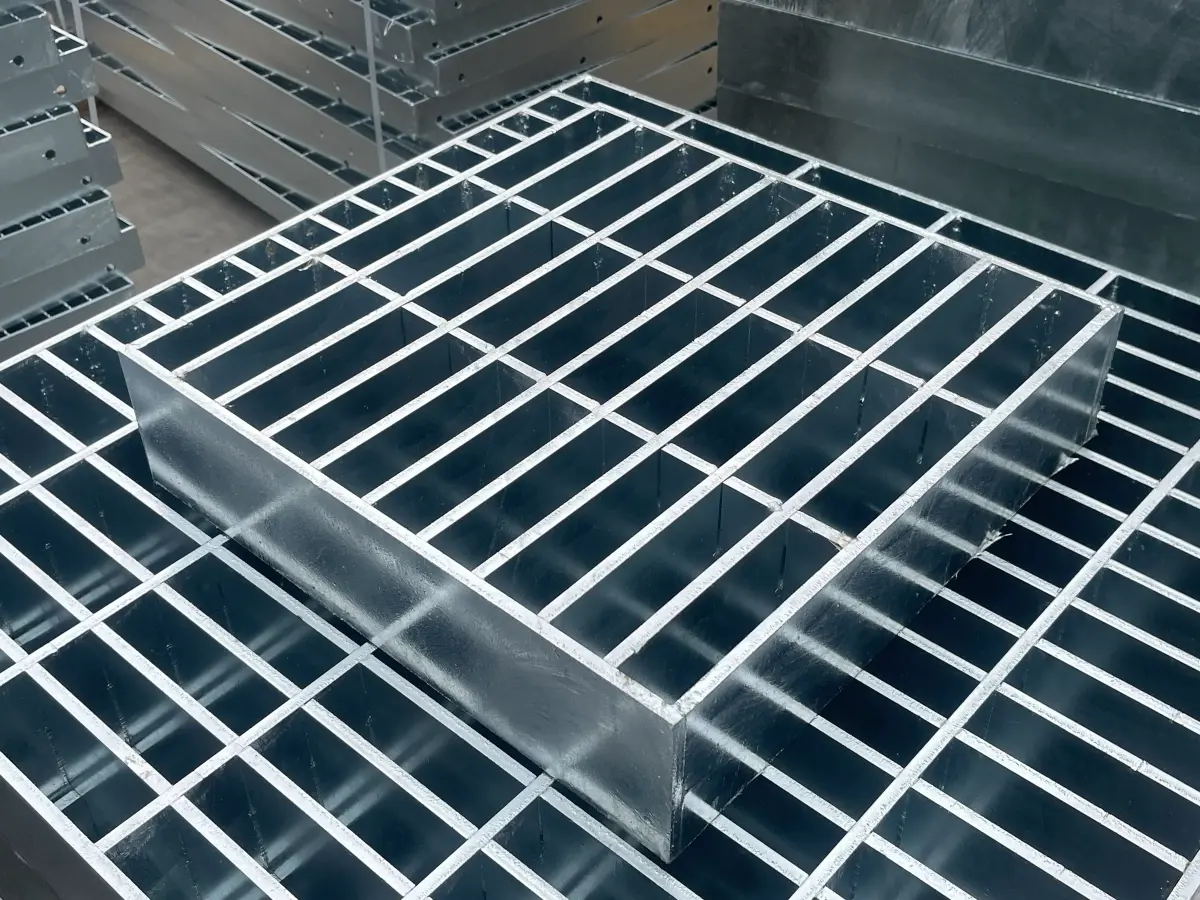
Heavy Duty Grating Cutout
Built for extreme industrial environments. This heavy-gauge sample lets your engineers physically test the weldability, thickness, and structural rigidity designed for offshore platforms and heavy vehicle traffic.
Heavy Duty Grating: Engineering for Extreme Load Applications
Heavy duty safety grating is engineered for industrial environments where standard-gauge grating cannot meet load requirements. Manufactured from 4.0mm to 6.0mm thick carbon steel plate, these panels support heavy vehicle traffic, forklift operations, and concentrated point loads found on offshore platforms, mining haul roads, port facilities, and heavy industrial plant floors.
The manufacturing process uses high-tonnage CNC punching presses (400-800 ton capacity) to form the anti-slip pattern through thick plate material while maintaining consistent hole geometry and tooth formation. Unlike thin-gauge grating that can be formed on standard progressive dies, heavy duty panels require specialized tooling designed for the increased forming forces — ensuring clean shear edges without material cracking or deformation that would compromise structural integrity under cyclic loading.
Material selection for heavy duty applications typically specifies Q345B (equivalent to S355JR) or higher-strength grades that provide improved yield strength (minimum 345 MPa) compared to standard Q235B (235 MPa). This allows engineers to specify longer unsupported spans or higher load ratings without increasing panel thickness. For offshore and marine applications, material may be specified with Charpy impact testing at -20°C or -40°C to ensure ductile behavior in cold environments.
The mill-finish sample provided allows buyers to conduct their own weldability testing — verifying that the material accepts fillet welds and butt welds without preheating requirements, and that the heat-affected zone maintains acceptable hardness levels. This is particularly important for projects where grating panels will be welded directly to structural frames rather than bolted through clip connections. Surface treatment for production orders includes hot-dip galvanizing (ISO 1461, typical coating weight 915 g/m² for 4mm material), epoxy primer systems for subsequent site painting, or bare supply for buyer-specified coating application.
Load Capacity by Thickness
| Thickness | Load (kN/m²) | Span | Use |
|---|---|---|---|
| 4.0mm | 5.0 | 800mm | Forklifts |
| 5.0mm | 7.5 | 1000mm | Offshore |
| 6.0mm | 10.0 | 1200mm | Mining |
Industrial Uses
Offshore
Helideck surrounds, marine protection.
Mining
Crusher decks, ore traffic.
Steel Mills
High-temp zones.
Service Bays
Equipment repair.
Frequently Asked Questions
How do I request this sample?
Click "Add to Sample Request" above to add this heavy-duty cutout to your evaluation kit. Multiple samples can be requested together. Shipping typically takes 5-7 business days worldwide via express courier.
What's the difference between 4mm, 5mm, and 6mm gauge?
Load capacity increases significantly: 4mm supports 5 kN/m² (forklifts, equipment platforms), 5mm handles 7.5 kN/m² (heavy vehicles, offshore platforms), 6mm rated for 10 kN/m² (mining trucks, steel mill walkways). Heavier gauge also allows longer unsupported spans.
Why is this sample provided in mill finish instead of galvanized?
Mill finish (bare steel) allows you to conduct weldability testing — verifying that your welding procedures produce acceptable joints without preheat or post-weld heat treatment. Production orders are available hot-dip galvanized, painted, or bare per your specification.
Can heavy-duty grating be used in marine/offshore environments?
Yes. Hot-dip galvanization per ASTM A123 provides 20+ year corrosion protection in salt spray environments. For extreme offshore exposure (helideck surrounds, splash zones), specify duplex coating: galvanization + epoxy topcoat for 30+ year service life.
What welding procedures are recommended?
Q235/A36 carbon steel welds readily via SMAW (stick), GMAW (MIG), or FCAW (flux-core). Use E6013 or E7018 electrodes. No preheat required for 4-6mm thickness. Fillet welds along panel edges or plug welds through holes both acceptable. Post-weld inspection via MT (magnetic particle) recommended for critical applications.
Can I order a larger sample or specific hole pattern?
Yes. Standard samples are 300x300mm, but we provide custom sizes up to 600x600mm at no charge for qualified projects. Special hole patterns, slot configurations, or nosing profiles can be sampled if you're evaluating for production. Email requirements to support@leadingtopunion.com.
What certifications and test reports are provided with production orders?
Mill test certificates (3.1 per EN 10204) with chemical composition and mechanical properties. Galvanization certificates per ASTM A123/ISO 1461. Impact testing (Charpy V-notch at -20°C or -40°C) available for offshore/cold climate projects. Material traceability via heat number stamping.
What are typical lead times and minimum order quantities?
Standard sizes (1220x2440mm): 4-5 weeks production, MOQ 150 m². Custom sizes or special materials (Q345B, weathering steel): 6-8 weeks, MOQ 250 m². Prototype/sampling runs (10-20 panels) available at premium pricing for project qualification.
Can you match a competitor's heavy-duty grating specification?
Yes. Send us competitor drawings, material specs, or physical samples. Our engineering team will reverse-engineer the design, match dimensions/tolerances, and provide equivalent or superior performance. Common reference standards: ASTM A1011 (steel), ASTM A653 (galvanized), ANSI/NAAMM MBG 531 (grating).
Is this suitable for high-temperature applications?
Standard Q235/A36 steel is rated to 200°C continuous service. For higher temperatures (steel mill walkways, furnace access platforms), specify heat-resistant grades: Q345D (-20°C impact), S355J2 (-20°C), or specialized high-temp alloys up to 600°C. Consult our engineering team for thermal expansion calculations.
Related Products & Services
Request a Heavy Duty Grating Sample Today needs