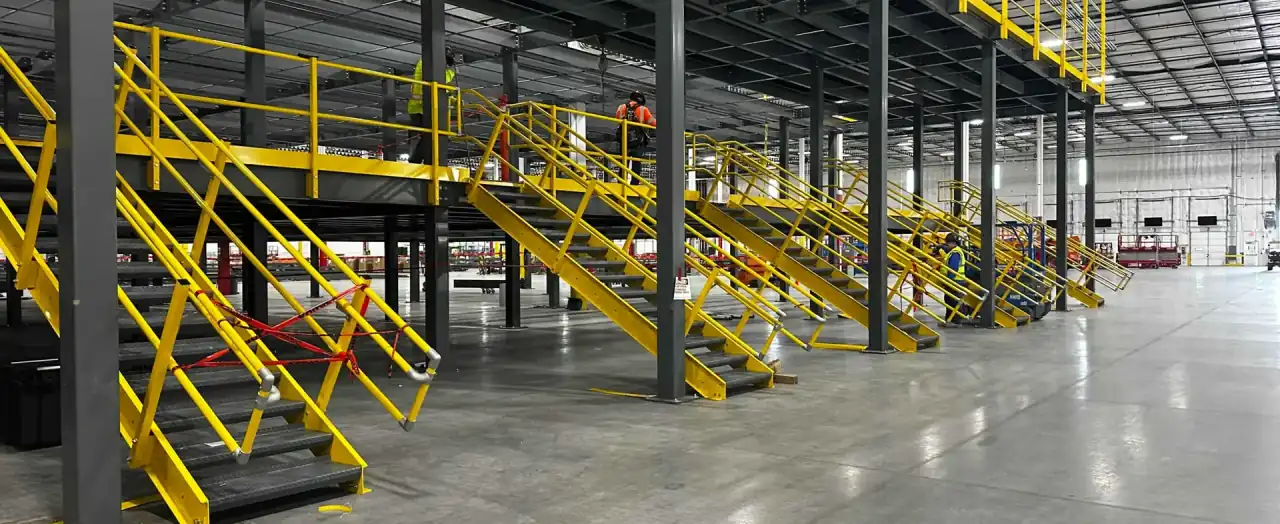
Industrial Platform Structures
Custom industrial platform structures for process plants, power stations, and manufacturing facilities. We design and fabricate multi-level platforms with integrated stairs, handrails, grating, and equipment supports.
Custom industrial platform structures for process plants, power stations, and manufacturing facilities. We design and fabricate multi-level platforms with integrated stairs, handrails, grating, and equipment supports.
30,000 T/Year Capacity
Plate up to 200mm
AWS D1.1 / EN 1090
Full NDT Testing
Industrial platform structures from Leading Top Union are engineered for demanding environments where load-bearing capacity, structural integrity, and long-term corrosion resistance are non-negotiable. Fabricated in our Suzhou facility under ISO 3834-2 certification, these platforms support multi-level access up to 30 meters in height with column sections ranging from HEB/HEA 100 to HEB/HEA 1000, plus custom box sections for specialized applications. Beam spans extend to 12 meters, allowing open layouts for equipment access and material flow. Floor loading is designed to 5-25 kN/m², accommodating heavy machinery, personnel, and stored materials simultaneously. Every structure complies with EN 1090-2 EXC2 or EXC3 execution classes, ensuring traceability, weld quality, and dimensional accuracy per European standards.
The modular design philosophy reduces on-site labor and crane time by up to 40% compared to welded-in-place alternatives. Each platform section is pre-engineered with bolted connections, allowing rapid assembly without hot work in hazardous areas. Integrated stair towers, ladder systems, and handrails are included as standard components, all designed to OSHA 1910.23 and EN ISO 14122-2 requirements for safe egress and fall protection. Surface treatment options include hot-dip galvanizing per ASTM A123 (minimum 85 microns), three-coat paint systems for offshore environments, or powder coating for interior installations. For elevated temperature applications up to 400°C, high-temperature coatings and expansion joint provisions are specified to maintain structural stability.
Full 3D finite element analysis (FEA) using STAAD.Pro and SolidWorks is performed by our engineering team, verifying deflection limits to L/200 for floors and L/150 for cantilevers under live load. Wind loads are calculated per ASCE 7-22 or EN 1991-1-4, with seismic design per ASCE 7 or EN 1998-1 where required. Connection design follows AISC 360-16 or EN 1993-1-8, with slip-critical bolted joints for high-vibration environments. Weld procedures are qualified under AWS D1.1 for carbon steel and AWS D1.6 for stainless steel, with NDT inspection rates of 100% for critical welds (ultrasonic testing per ASTM E164) and 10% random magnetic particle testing per ASTM E709 for secondary connections. This ensures zero structural failures in service.
Material selection is critical for long-term performance. Structural steel is sourced to EN 10025-2 (S235JR, S355J2, S460ML) and ASTM A36/A572 Gr. 50, with mill certificates traceable to the heat number. For corrosive environments, duplex stainless steel (UNS S31803) or weathering steel (ASTM A588) is available. Floor grating options include serrated bar grating (19 mm spacing, 5 mm thickness) for slip resistance, chequer plate (6 mm minimum), or solid plate with anti-skid coating. All platforms include drainage provisions to prevent water pooling, with 1:50 slope on open grating and weep holes on solid surfaces. The result is a structure that maintains its design capacity for 25+ years with minimal maintenance, even in coastal or chemical processing environments.
In oil and gas upstream and midstream operations, industrial platform structures serve as wellhead access platforms, pig launcher/receiver supports, and pipe rack bridges. For a recent project in the Permian Basin, 12-meter-high platforms were supplied supporting 15 kN/m² live load with integrated stair towers and cantilevered work decks for valve access. The structures were hot-dip galvanized per ASTM A123 and designed to API RP 2A-WSD for wind and wave loading, with bolted connections for rapid field assembly. Platform grating was 25 mm x 5 mm serrated bar grating to prevent slips in wet conditions. All welds met AWS D1.1 with 100% UT inspection on full-penetration joints, ensuring zero defects in hydrogen sulfide (H2S) service environments.
Offshore wind energy projects demand platforms that withstand cyclic loading, salt spray, and extreme weather. Transition piece platforms, turbine access decks, and cable ladder supports are fabricated for offshore substations. A typical design for a 15 MW turbine includes a 20-meter-high platform with HEB 600 columns and 8-meter beam spans, supporting 10 kN/m² for maintenance personnel and tooling. Surface treatment is hot-dip galvanized plus a three-coat epoxy/polyurethane system (minimum 300 microns DFT) per NORSOK M-501 for 25-year corrosion protection. Connections are designed for fatigue per DNV-RP-C203, with weld toe grinding to improve fatigue life by 30%. Platforms include davit cranes for lifting components up to 2 tons and fall arrest anchor points per EN 795 Class A.
Mining and mineral processing facilities require heavy-duty platforms for crushers, conveyors, and screening equipment. Dynamic loads from vibrating machinery are handled with floor loading up to 25 kN/m² and impact factors of 1.5 per AS 4324.1. For a copper mine in Chile, a 15-meter-high multi-level platform was supplied with S460ML steel columns (HEB 800) and 10-meter beam spans, supporting a 200-ton cone crusher. The design included vibration isolation pads (natural frequency 8 Hz) and stiffened connections to prevent fatigue cracking. Surface treatment was a three-coat system (zinc-rich primer, epoxy intermediate, polyurethane topcoat) to resist abrasive dust and chemical reagents. All platforms included walkways with 1.8-meter handrails and mid-rails per OSHA 1910.23, with toe boards to prevent tool drops.
Power generation plants—including combined cycle, coal-fired, and biomass facilities—rely on these platforms for boiler access, turbine decking, and cooling tower maintenance. For a 600 MW supercritical coal plant, 25-meter-high platforms were fabricated with HEB 900 columns and 12-meter beam spans, supporting 20 kN/m² for heavy equipment replacement. The design incorporated thermal expansion joints every 30 meters to accommodate 100°C temperature differentials. Surface treatment was a high-temperature silicone-based coating rated to 400°C for areas near boiler casings. Platforms included integrated monorails for lifting turbine components up to 10 tons and emergency egress stair towers with fire-rated enclosures. All structures met ASME B30.20 for below-the-hook lifting devices and NFPA 85 for boiler safety.
Petrochemical and chemical processing facilities demand platforms that resist corrosive atmospheres and support complex piping systems. Pipe rack platforms are designed with beam spans up to 12 meters and column grids optimized for pipe routing, with cantilevered extensions for valve access. For an ethylene cracker expansion in Texas, 18-meter-high platforms were supplied with S355J2 steel (impact tested to -20°C) and stainless steel grating (304L) for chlorine service areas. The design included 50 mm diameter drain holes every 2 meters to prevent liquid accumulation and 1.5-meter-wide walkways with slip-resistant grating. Surface treatment was a three-coat system per SSPC-Paint 20 for immersion service, with dry film thickness of 400 microns. All platforms were designed to ASME B31.3 for pipe support loads and OSHA 1910.29 for ladder safety.
Leading Top Union holds ISO 3834-2, EN 1090-2 EXC3, and AWS D1.1 certifications, providing independent verification of fabrication quality. The Suzhou factory operates with CNC plasma cutting (Hypertherm HPR260), robotic welding cells (FANUC and ABB), and automated shot blasting to Sa 2.5 per ISO 8501-1. Every platform structure is dimensionally inspected using laser scanning (FARO Focus S350) with tolerance of ±2 mm on bolt hole locations and ±5 mm on overall dimensions. Full traceability is maintained from mill certificate to final inspection report, with weld maps and NDT records archived for 10 years. This documentation satisfies EPC contractors requiring ISO 9001:2015 quality management systems and project-specific inspection and test plans (ITPs).
Complete structural design, connection design, and erection engineering are provided as part of the package by our engineering team. 3D modeling in Tekla Structures is performed for clash detection with piping, electrical, and HVAC systems, reducing field modifications by 25%. For international projects, designs are adapted to local building codes (IBC, Eurocode, GB 50017) and seismic zones (UBC Zone 4, EN 1998-1). Value engineering is also offered to optimize steel weight by 10-15% without compromising safety, using high-strength steels (S460, S690) and efficient bracing configurations. Delivery times are 8-12 weeks for standard designs, with expedited options for critical path items. Container shipping or break-bulk cargo is coordinated to any global port, with full documentation for customs clearance.
Every industrial platform structure is backed with a 5-year warranty against manufacturing defects and a 25-year design life guarantee when maintained per our guidelines. After-sales support includes remote installation supervision via video call or on-site technical assistance within 72 hours for urgent issues. A spare parts inventory is maintained for common components (bolts, grating clips, handrail fittings) with replacements shipped within 5 business days. For ongoing projects, annual inspection services are offered to check for corrosion, bolt tension loss, and structural deformation, providing detailed reports with repair recommendations. This commitment to lifecycle support reduces total cost of ownership and ensures the platform remains safe and operational for decades.
| Capability | Specification |
|---|---|
| Max Height | 30m (multi-level) |
| Column Sections | HEB/HEA 100-1000, custom box sections |
| Beam Spans | Up to 12m |
| Floor Loading | 5-25 kN/m² design load |
| Surface Treatment | HDG / painted / powder coated |
| Standards | EN 1090-2 EXC2/EXC3, AISC |
Send us your requirements and we will respond within 24 hours with pricing and lead time.