Product Overview
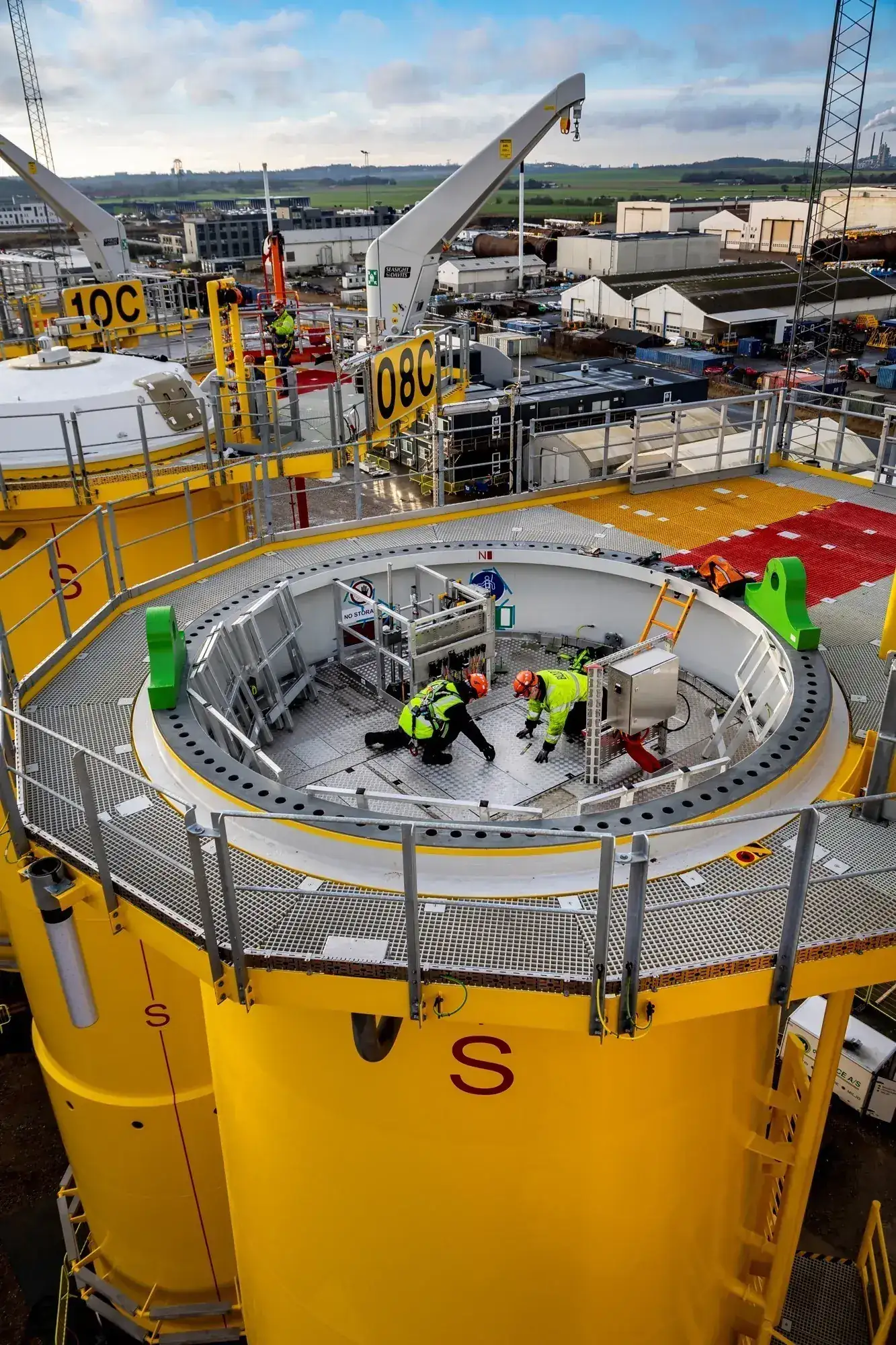
Secondary steel structures form the critical interface between primary load-bearing members and operational equipment on offshore wind foundations, oil and gas platforms, and marine infrastructure. Complete secondary steel packages are engineered and fabricated by Leading Top Union, including internal platforms, boat landing systems, cable tray routing, anode cages, and pre-assembled modules. ISO 3834-2, EN 1090-2 EXC3, and AWS D1.1 certifications govern the Suzhou production facility, ensuring every weld and assembly meets the stringent requirements of DNV-GL and ABS classification societies. Standard platform loads are designed for 5 kN/m², with custom configurations available for dynamic loading conditions up to 10 kN/m² in high-traffic zones.
Material Selection and Engineering Standards
Material selection for secondary steel structures follows a rigorous engineering process based on service environment and fatigue life requirements. S355J2 and S355JR structural steel plates and sections are primarily utilized, with Charpy V-notch impact testing at -20°C for offshore applications. For boat landing systems and fender panels exposed to continuous wave action, S355NL or S420ML grades with enhanced through-thickness properties (Z15 to Z35) per EN 10164 are specified. All gratings are supplied as Grip Strut or welded bar grating conforming to EN ISO 14122-3 for walkways and platforms, with slip resistance values exceeding 0.6 R9 classification. Finite element analysis (FEA) is performed on all load-bearing secondary steel components to verify deflection limits under combined dead, live, and environmental loads.
Corrosion Protection and Coating Systems
Corrosion protection for secondary steel structures is engineered for a minimum 20-year service life in C5-M marine environments. A zinc-rich epoxy primer at 80μm DFT, followed by a high-build epoxy intermediate coat at 160μm DFT, and a polyurethane topcoat at 80μm DFT comprises the standard coating system, achieving a total dry film thickness of 320μm minimum. For cathodic protection supports and anode cages, thermally sprayed aluminum (TSA) coatings per ISO 2063 or galvanizing to ASTM A123 with minimum 85μm thickness are applied. All coating systems are tested for adhesion per ISO 2409, salt spray resistance per ASTM B117 for 1,000 hours, and cyclic corrosion per ISO 20340. Pre-assembled modules are delivered with complete coating inspection reports, including holiday detection at 100% surface area.
Fabrication Precision and Quality Assurance
Precision cutting, robotic welding, and dimensional inspection are integrated into the secondary steel fabrication process to achieve tolerances of ±2mm over 6-meter lengths for structural members. Welding procedures are qualified per ISO 15614-1 and AWS D1.1, with NDT coverage including 100% visual inspection, 20% magnetic particle testing on fillet welds, and 10% ultrasonic testing on butt welds. For boat landing systems, elastomeric fender panels rated for 50-year fatigue life per PIANC guidelines are incorporated, with energy absorption capacities from 50 kJ to 200 kJ depending on vessel approach velocity. Cable tray systems are designed with 50mm x 50mm mesh spacing and hot-dip galvanized finish, supporting cable loads up to 150 kg/m with deflection under 1/200 span. Every secondary steel package includes a complete material traceability dossier per EN 10204 3.1 certification.
Applications & Industries
Offshore wind energy projects represent the largest application segment for secondary steel structures, where monopile and jacket foundations require extensive internal platforms, ladders, and cable management systems. For a recent 1.2 GW offshore wind farm in the North Sea, 84 complete secondary steel packages were supplied including boat landing systems with 150 kJ fender panels, internal platforms rated for 5 kN/m², and pre-assembled anode cages supporting 12 cathodic protection anodes each. These structures are designed for 25-year fatigue life under wave loading conditions per DNV-OS-J101, with S355J2 material certified to EN 10025-2 and coating systems validated for 1,000-hour salt spray resistance. Pre-assembled modules reduced offshore installation time by 40% compared to stick-built alternatives, directly lowering vessel charter costs for the EPC contractor.
Oil and Gas Platform Applications
In the oil and gas sector, secondary steel structures support critical safety and operational functions on fixed platforms, FPSOs, and subsea templates. Handrails and guardrails conform to EN ISO 14122-3 with 1,100mm height, intermediate rails at 550mm, and toe plates at 100mm, tested for 1.5 kN/m horizontal load capacity. For a petrochemical facility in the Middle East, 450 tonnes of secondary steel were fabricated including cable tray supports rated for 120 kg/m, platform grating with 30mm x 30mm mesh for personnel safety, and boat landing systems with 200 kJ fender panels for 5,000 DWT supply vessels. All structures were designed for 50°C ambient temperature with S355JR material and C5-M coating system per ISO 12944-5, including 100% NDT coverage on critical welds. Delivery included pre-assembled modules up to 12 meters in length, reducing offshore hook-up time by 35%.
Mining and Power Generation Infrastructure
Mining and mineral processing facilities demand secondary steel structures that withstand abrasive environments and heavy dynamic loads. Internal platforms for crusher stations and conveyor transfer towers are designed for 7.5 kN/m² live loads with S355J2 material and 400μm DFT coating systems including epoxy mastic for abrasion resistance. For a copper mine in Chile, 320 tonnes of secondary steel were supplied including walkway gratings with 38mm x 38mm mesh and 6mm bearing bars, handrails per EN ISO 14122-3, and cable tray systems supporting 200 kg/m for high-voltage power cables. All structures were hot-dip galvanized per ASTM A123 with minimum 100μm thickness, tested for adhesion and uniformity. Pre-assembled modules allowed rapid installation during a 21-day plant shutdown, with dimensional tolerances of ±3mm verified by laser scanning before shipment.
Power generation facilities, including thermal, nuclear, and hydroelectric plants, require secondary steel structures that meet strict seismic and safety standards. Cable tray and routing systems for a 2,000 MW combined-cycle gas turbine plant were designed for seismic Zone 4 per ASCE 7-16, with S355J2 supports rated for 0.5g horizontal acceleration. Platform gratings were supplied with 30mm x 30mm mesh and 5mm bearing bars, tested for 5 kN/m² load with deflection under 1/200 span. For nuclear applications, secondary steel is fabricated per ASME NQA-1 and 10 CFR 50 Appendix B, with full material traceability and 100% NDT coverage. Coating systems for power generation include high-temperature resistant epoxy for areas up to 120°C and intumescent fireproofing for escape routes, achieving 60-minute fire resistance per EN 13501-2.
Shipbuilding and Marine Applications
Shipbuilding and marine repair yards utilize secondary steel structures for dry docks, floating docks, and ship outfitting. Boat landing systems for a 300-meter floating dry dock in Singapore included fender panels rated for 300 kJ energy absorption, with S355J2 brackets and hot-dip galvanized finish per ASTM A123. Internal platforms and ladders were designed for 5 kN/m² load with S355JR material and 320μm DFT coating system, tested for 1,000-hour salt spray resistance. Pre-assembled modules up to 15 meters in length reduced installation time by 50% compared to traditional methods, with all welds inspected per AWS D1.1 and NDT coverage including 100% magnetic particle testing on critical connections. Complete 3D modeling and clash detection using Tekla Structures was provided by the engineering team, ensuring seamless integration with shipyard workflows.
Why Choose Leading Top Union for Secondary Steel Structures
ISO 3834-2, EN 1090-2 EXC3, and AWS D1.1 certifications are combined with over 15 years of experience in fabricating secondary steel structures for global offshore and industrial projects at Leading Top Union. Five production lines dedicated to secondary steel operate at the Suzhou facility, with annual capacity exceeding 12,000 tonnes. A 98.5% on-time delivery rate for pre-assembled modules is maintained, supported by a quality management system that includes 100% material traceability per EN 10204 3.1, NDT coverage on all critical welds, and dimensional inspection using laser trackers with ±0.5mm accuracy. Complete 3D modeling, FEA analysis, and clash detection using Tekla Structures and ANSYS is provided by the engineering team, ensuring every secondary steel package integrates seamlessly with primary structures and equipment.
Rapid Installation and Pre-Assembled Modules
Secondary steel structures are engineered for rapid offshore installation, with pre-assembled modules designed for single-lift operations using cranes up to 500 tonnes capacity. Each module includes pre-installed gratings, handrails, cable trays, and anode cages, with all connections designed for bolted assembly using ASTM A325 or A490 high-strength bolts. For a recent 800 MW offshore wind project in Taiwan, 56 pre-assembled modules averaging 12 tonnes each were delivered, reducing offshore installation time by 45% and saving the EPC contractor over 2,000 vessel-hours. Coating systems are validated by independent third-party testing per ISO 20340 for 4,200-hour cyclic corrosion resistance, ensuring 20-year service life in C5-M environments. Complete documentation including coating inspection reports, NDT reports, material certificates, and as-built 3D models for asset management is provided.
Engineering Support and Global Logistics
Comprehensive engineering support from concept design through detailed fabrication drawings is offered, including structural calculations per Eurocode 3, AISC 360, or DNV-OS-C401 as required by project specifications. Experience with secondary steel for projects in the North Sea, Gulf of Mexico, South China Sea, and Middle East is held by the team, addressing diverse environmental conditions from -30°C to 55°C operating temperatures. Full logistics support including sea freight, customs clearance, and on-site delivery coordination is provided, with packaging designed for marine transport per ISPM 15 and DNV-GL cargo securing guidelines. For urgent projects, fabrication schedules can be accelerated to 8-10 weeks from order to shipment, with dedicated project management and weekly progress reporting. A detailed proposal including engineering calculations, fabrication schedule, and cost estimate for secondary steel requirements is available from the technical sales team.