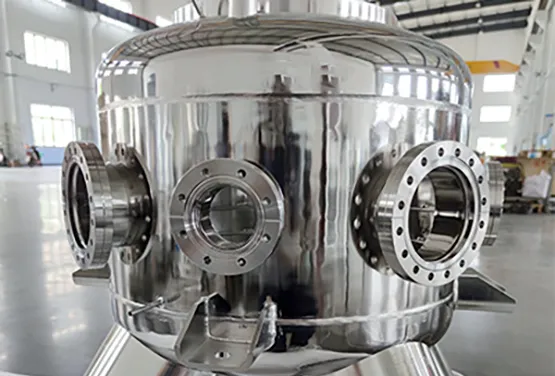
UHV process chambers in 316L with CF and ISO-K port geometry
Six 316L chambers, O900 x 1,400 mm, knife-edge CF flanges machined to the 30-degree sealing face, internal weld dressing to Ra 0.8 um or better, bake-out before packing, crated for air freight.
Figures from the project quality dossier. Certificate holders are named per the certificate register; Leading Top Union coordinated engineering, inspection follow-up and export documentation.
What made it hard
Knife-edge CF flanges distort as soon as heat goes into the adjacent wall, and a chamber that leaks at 1e-8 cannot be recovered by retouching the seal face. The port pattern also had to land within a tolerance that still let the customer bolt on their own gate valves in the cleanroom, so every flange was a datum, not a detail.
How we controlled it
Port bosses were machined before welding and finish-machined after, with the sealing face held back until the chamber had been stress-relieved. Welding ran to a qualified WPS with TIG root and argon back purge, weld-logged per chamber, and each shell was leak-checked twice: once on the sub-assembly and once after final assembly and bake.
Result
All six chambers passed the helium test on first presentation, CMM results stayed inside +/-0.02 mm on every port centre, and the chambers shipped bagged with the weld log, material certificates and leak records in the crate. The remaining risk on this product family is particle cleanliness: the class of the cleaning cell has to be confirmed per project, so we quote it as a project-specific requirement rather than a fixed claim.
What we would check first on a similar job
Three things decide whether a chamber project is quiet or expensive: the datum scheme on the flange pattern, whether the sealing faces are machined after stress relief, and how the cleaning and bagging is specified. Ask for the CMM report on the first chamber before the other five are released, and agree the leak-test method and the acceptance value in writing, because 1e-9 and 1e-8 are different manufacturing routes.
Same process on your drawings
Send the drawing and specification set; we reply with the fabrication route, the inspection plan and the certificate requirement per item.